Dennis Lloyd Martin — Disappearance Profile
PRN Disappearances — Factual Case Reference
- Name
- Dennis Lloyd Martin
- Disappeared
- 14 June 1969
- Location
- Spence Field, Great Smoky Mountains National Park, Tennessee, USA
- Age
- 6 (six days before his seventh birthday)
- Status
- MISSING — listed on NPS Investigative Services Branch cold cases page and NamUs (case #MP2370). No remains have ever been found.
Dennis Lloyd Martin, aged six, vanished on 14 June 1969 during a family camping trip to Great Smoky Mountains National Park, Tennessee, USA. He was last seen near Spence Field; the subsequent search — the largest in the park's history — found no trace. The case remains officially open and unresolved.
What is documented
Dennis Lloyd Martin was born June 20, 1962, and lived in Knoxville, Tennessee. On Father's Day weekend 1969, he was on a family camping trip to Great Smoky Mountains National Park — an annual tradition for the Martin family. The party consisted of Dennis, his father William Clyde Martin, his grandfather Clyde Demetrius Martin, and his older brother Douglas Martin. They hiked from Cades Cove to Russell Field, camped overnight, then hiked to Spence Field near the Appalachian Trail on June 14.
At approximately 4:30 p.m. on June 14, Dennis and several other children from a second family camping nearby were playing near the trail. Dennis's father observed the group of children crouching in bushes at the side of the trail, apparently preparing to surprise the adults walking down the path. Dennis was last seen going behind a bush. After approximately five minutes, when all the other children had returned to the campsite and Dennis had not, his father became alarmed and ran down the trail for nearly two miles — far enough that, at the pace a six-year-old could travel, Dennis could not have gone further unaided. After several more hours of searching, the family sought help from National Park Service rangers.
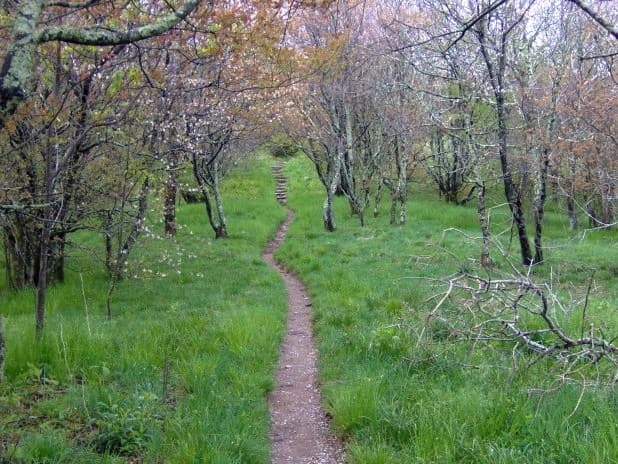
The area around Spence Field is characterised by steep slopes, ravines, and dense vegetation. Wildlife in the area includes black bears, copperhead snakes, feral hogs, and bobcats. Shortly after Dennis went missing, a severe rainstorm dropped approximately 3 inches of rain within hours, washing out trails and flooding streams. Temperatures that night fell to near 50°F (10°C).
Child-sized footprints were later found in the search area. They led to a stream, where they stopped. One foot in the prints appeared bare; the other matched an Oxford-style shoe of the type Dennis was wearing. NPS officials initially attributed the prints to a Boy Scout participating in the search. Retired park ranger and author Dwight McCarter has argued in his published account that the prints more likely belonged to Dennis, because they were not part of a group trail and none of the Boy Scouts were searching while barefoot.
A separate reported sighting occurred on the afternoon of the disappearance. Tourist Harold Key and his family stated they heard what Key described as "an enormous, sickening scream" and shortly thereafter saw an unkempt, dishevelled man running up the trail. Key stated the man appeared to be carrying cloth or clothing that was red — the colour of Dennis's shirt. Key's account was taken by investigators. Park rangers and the FBI concluded that the sighting could not be reliably linked to Dennis's disappearance: Key's location was approximately five miles from where Dennis was last seen as the crow flies, and seven to nine miles by trail, making it physically improbable that a six-year-old child could have covered that distance in the intervening time.
Several years after the disappearance, a ginseng hunter reported finding the scattered skeletal remains of a small child in Big Hollow, Tremont. He said he had not reported the find immediately because he feared prosecution for illegal ginseng collection. A subsequent search of the area turned up nothing.
Search and official investigation
The NPS initiated a formal search on June 14, 1969. The effort grew to become the largest search-and-rescue operation in the history of Great Smoky Mountains National Park and one of the most extensive in US national park history.
Approximately 1,400 people participated at peak, covering a 56-square-mile area. Resources deployed included:
- National Park Service rangers
- Tennessee National Guard units
- US Army Green Berets (Special Forces)
- Volunteer search parties
- Search dogs
The scale of the search was later identified as a contributing factor to its failure: the large number of participants — many of them volunteers without search-and-rescue training — likely obscured potential evidence and made coordination extremely difficult.
Heavy rain on the first day and persistent mist in subsequent days significantly hampered operations. The formal search was scaled back on June 26, 1969. A final organised search took place on June 29, 1969, after which the active search was abandoned. The case was officially closed on September 14, 1969. Final estimated cost: $50,000 (approximately $415,000 in 2024 dollars).
Dennis's father offered a $5,000 reward for information leading to his son's whereabouts.
The FBI was contacted by the Martin family, who pressed for the Bureau's involvement. The FBI stated that it could only open a formal investigation if there was evidence of kidnapping or foul play. Following a June 29 meeting between the Martin family, an FBI agent, the chief ranger, and two other rangers, the Bureau concluded there was insufficient evidence to support a kidnapping determination.
The Dennis Martin case directly prompted the NPS to review and reform its search-and-rescue policies, particularly around volunteer coordination and search size management. It is cited in published SAR literature as a case study in large-scale search management.
Ordinary explanations considered
Park officials have consistently identified exposure and becoming lost as the most probable explanation for Dennis's fate. The following ordinary factors are noted:
- Exposure and death from the elements: A six-year-old alone in mountainous terrain on a night when temperatures dropped to near 50°F, following heavy rainfall, faced severe risk of hypothermia. A child of that age and size has very limited reserves of heat and energy. NPS officials and SAR literature regard it as likely that Dennis died from exposure during or shortly after the first night, which would explain why his remains were never found: the terrain is extremely rugged, the search was compromised by weather and management problems, and without a starting point for remains, recovery in dense mountain forest is not guaranteed even after intensive effort.
- Animal predation: The area is inhabited by black bears and feral hogs. Either could cause death and the dispersal or concealment of remains. This is considered a plausible secondary explanation by some investigators, particularly given the terrain and the failure to find any physical trace.
- Accidental fall or injury: The steep slopes and ravines of the Spence Field area present serious injury risk for a child running or moving quickly in unfamiliar terrain, especially in rain.
- Getting lost: A six-year-old child who became separated and began moving — whether in play, panic, or simply wandering — could cover ground quickly in any direction, including into areas where search parties did not penetrate.
The footprints leading to a stream and stopping there have been cited by some investigators as consistent with the child having entered a watercourse, which would complicate tracking and could indicate drowning or downstream movement of remains.
The abduction theory (based on Harold Key's witness account) was evaluated by both NPS and the FBI and found to lack corroborating evidence. The geographical implausibility of the timeline further reduces its weight as an explanation. It is not the official position of any investigating agency.
What remains unexplained
The primary factual gap is the absence of any physical remains or trace after a 56-square-mile search involving 1,400 people. While this is consistent with the terrain difficulty, weather conditions, and search management problems, no definitive cause of death or location has ever been established.
The footprints at the stream — one bare, one matching Dennis's shoe — were dismissed by NPS officials but have not been fully accounted for. The attribution to a barefoot Boy Scout has not been verified.
Harold Key's witness account has never been resolved. It remains ambiguous: the timeline and geography are difficult to reconcile with the account reflecting Dennis's actual location, but Key's claim was never formally disproved.
In the absence of remains, no cause of death has been established.
Official resources and status
- NPS Investigative Services Branch cold cases
- NamUs case #MP2370
- NPS FOIA case file (redacted, publicly available)
- National Center for Missing & Exploited Children: case #1178747
Status as of June 2026: Missing. No remains recovered. Case listed as active cold case by NPS Investigative Services Branch.
Location & map
Spence Field, Great Smoky Mountains National Park, Tennessee
Pin position: Approximate — Spence Field, Great Smoky Mountains National Park
Sources
- NPS Investigative Services Branch cold cases page (official), last updated February 2025
- NamUs #MP2370 (US Department of Justice, official)
- NPS FOIA-released case file (redacted), 1969
- Wikipedia, "Disappearance of Dennis Martin" (sourced to Knoxville News Sentinel, Kingsport Times, Albuquerque Journal, and other contemporary press; also sourced to Dwight McCarter and Ronald Schmidt, Lost!: A Ranger's Journal of Search and Rescue, Graphicom Press, 1998; and Charles R. Farabee, Death, Daring, and Disaster: Search and Rescue in the National Parks, Taylor Trade Publications, 2005)
- Matt Lakin, "Missing in the Smokies: Dennis Martin's disappearance still haunts park, 50 years later," Knoxville News Sentinel, June 6, 2019
- Jim Balloch, "Search in Smokies for lost boy, Dennis Martin, produces lessons for future searches," Knoxville News-Sentinel, June 28, 2009
- WBIR, "Appalachian Unsolved: Dennis Martin, Missing in the Smokies" (local television, sourced to NPS records)
- Kentucky Emergency Management, "Dennis Martin Case Study" (PDF, official SAR training material)