Factor group
Electromagnetic & Radio-Frequency (EMF/RF) Interference
Man-made electromagnetic fields are everywhere — power cables, phone masts, broadcast transmitters, faulty house wiring — and the meters investigators rely on to detect anomalies respond to every one of them. This factor is context for an investigation: it tells you what mundane sources are in or near a site that a meter will pick up. It is not, on its own, evidence of anything paranormal.
What it is
Electromagnetic fields (EMF) are invisible areas of energy produced whenever an electric current flows. They sit on a continuous spectrum: at the low-frequency end are the 50 Hz fields from mains wiring; in the middle are radio-frequency (RF) signals from mobile networks and broadcast transmitters; at the high end sits ionising radiation. Paranormal investigation is concerned almost entirely with non-ionising EMF — the ELF (extremely low frequency) band below 300 Hz and the RF band from roughly 100 kHz to several GHz.
Electric fields are blocked by most building materials. Magnetic fields are not — they pass through walls, floors and the human body almost unimpeded. So a reading taken in the middle of a room can reflect wiring hidden inside the structure, external power infrastructure, or transmitters hundreds of metres away. The field has no respect for the room you are standing in.
The World Health Organisation's International EMF Project (established 1996) has consistently concluded that, at public exposure levels, the scientific evidence does not confirm harm from low-level fields. In the UK, regulatory limits are set on ICNIRP guidelines (the International Commission on Non-Ionizing Radiation Protection), enforced by Ofcom for the radio spectrum, and overseen by the UK Health Security Agency (UKHSA) for public-health matters. This is mainstream, well-regulated science, and we treat it as such.
At very high levels — far above any ordinary environment — short-term EMF exposure can produce real physiological effects (nerve and muscle stimulation). Whether sub-threshold chronic exposure causes subtle perceptual or psychological effects is actively researched but remains unresolved. We come back to that contested question in the subcategories, examples, and uncertainties sections.
Subcategories
Power Lines / High-Voltage Transmission Corridors
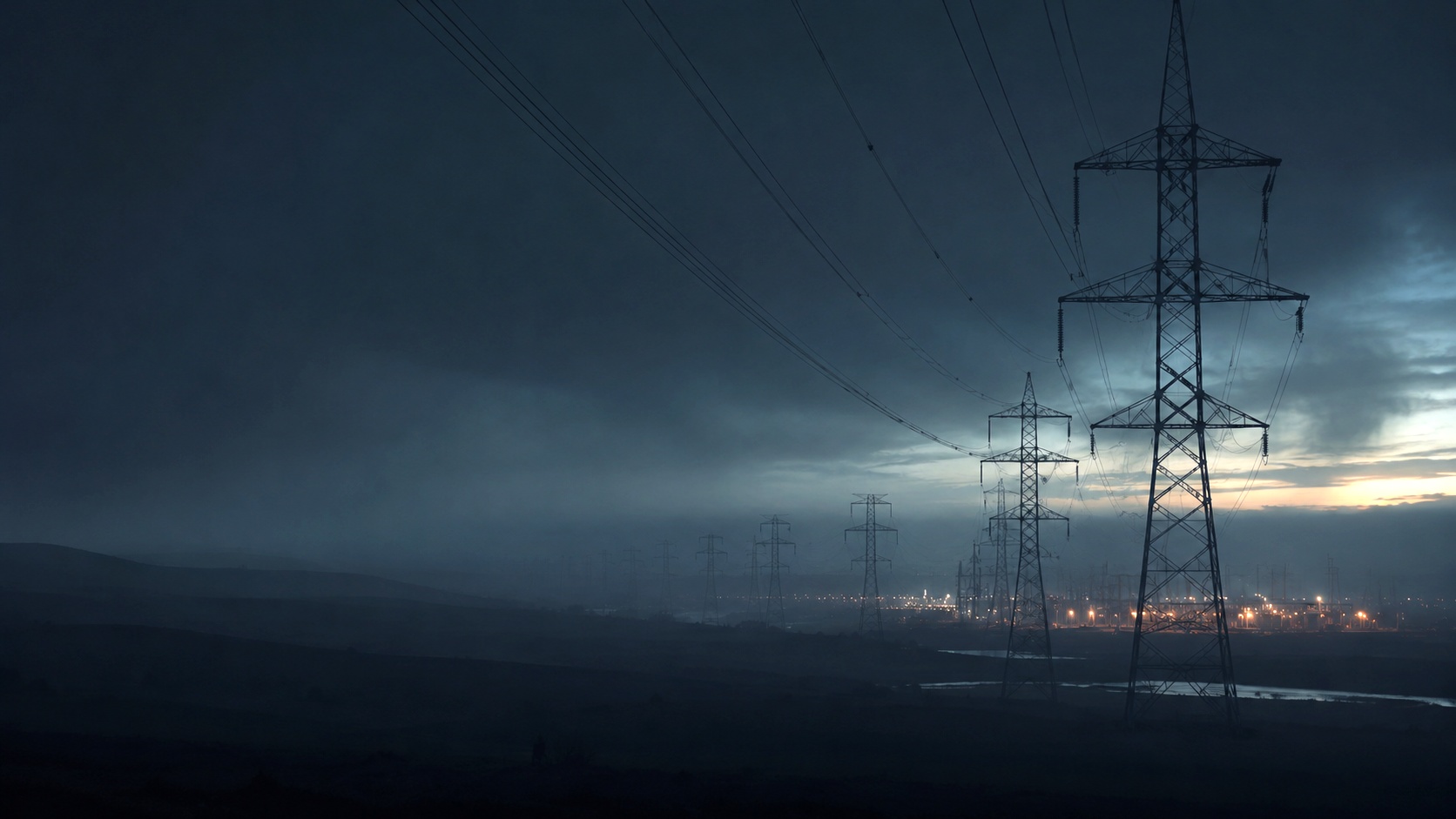
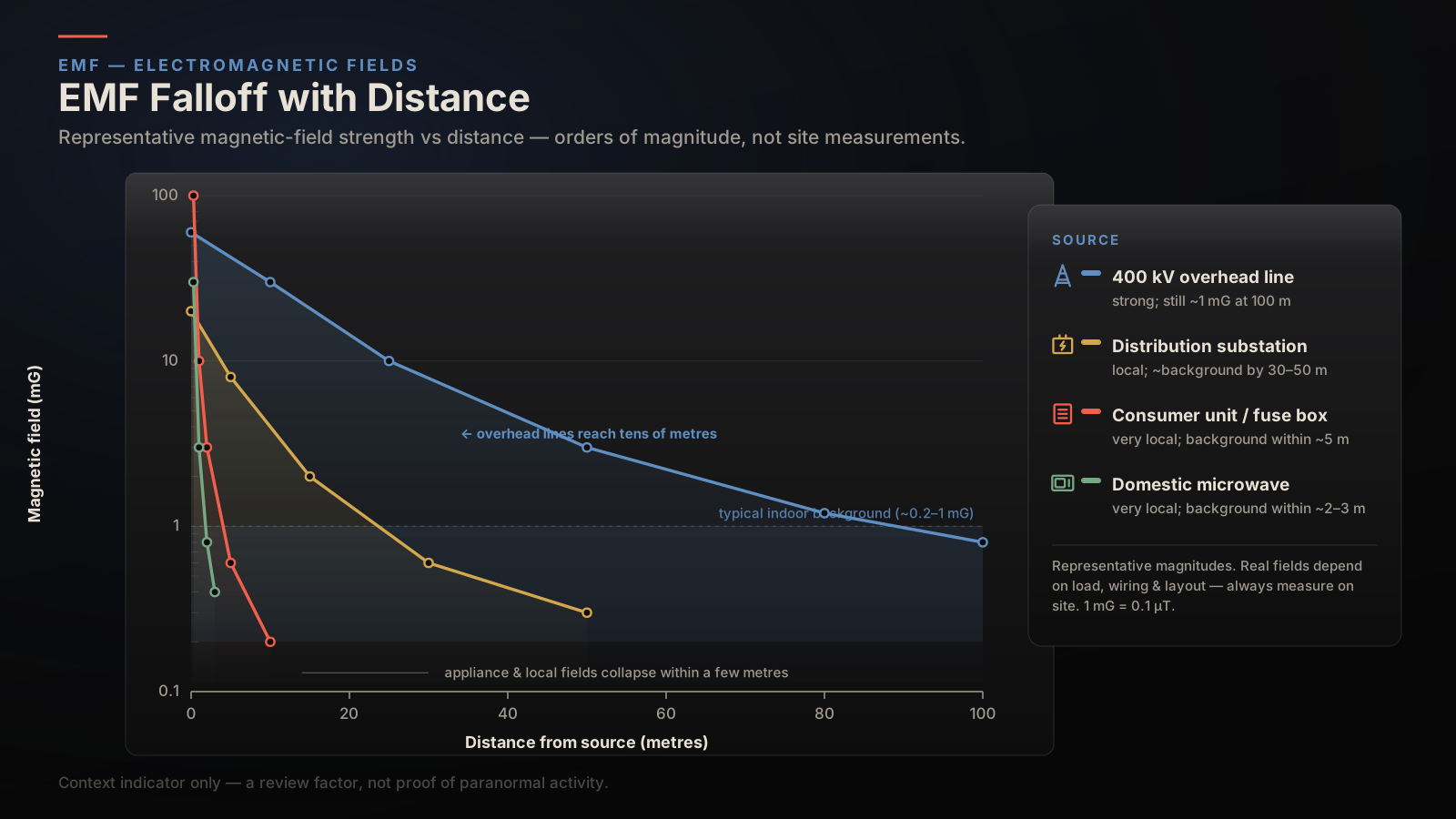
Overhead transmission lines running at 132 kV–400 kV produce the strongest ELF magnetic fields of any common infrastructure source. Field strength falls off rapidly with distance: the German Federal Office for Radiation Protection (BfS) found that residents living within 100 metres of a high-voltage line were exposed to only around 10% higher background fields than the general population. Directly beneath a 380 kV line, fields can reach several hundred milliGauss — still well below ICNIRP limits, but orders of magnitude above typical indoor background of 0.1–1 mG. If you are investigating near a transmission corridor, expect an elevated baseline EMF reading across the whole site perimeter, and treat that elevation as the corridor, not the case.
Electrical Substations
Substations step voltage down for local distribution and are surrounded by transformer fields and cabling. Studies reviewed by the Canadian National Collaborating Centre for Environmental Health note that magnetic-field exposure from substations drops off steeply with distance, and that engineering design — cable routing and shielding — strongly shapes the field footprint. At the fence line of a typical distribution substation, fields can be significant; by 25–50 metres they are back to background. Old or poorly maintained substations with unbalanced phases can throw out irregular field patterns that shift minute to minute, which is exactly the kind of "changing" reading that gets misread as activity.
Household Wiring, Faulty Wiring, and the "Fear Cage"
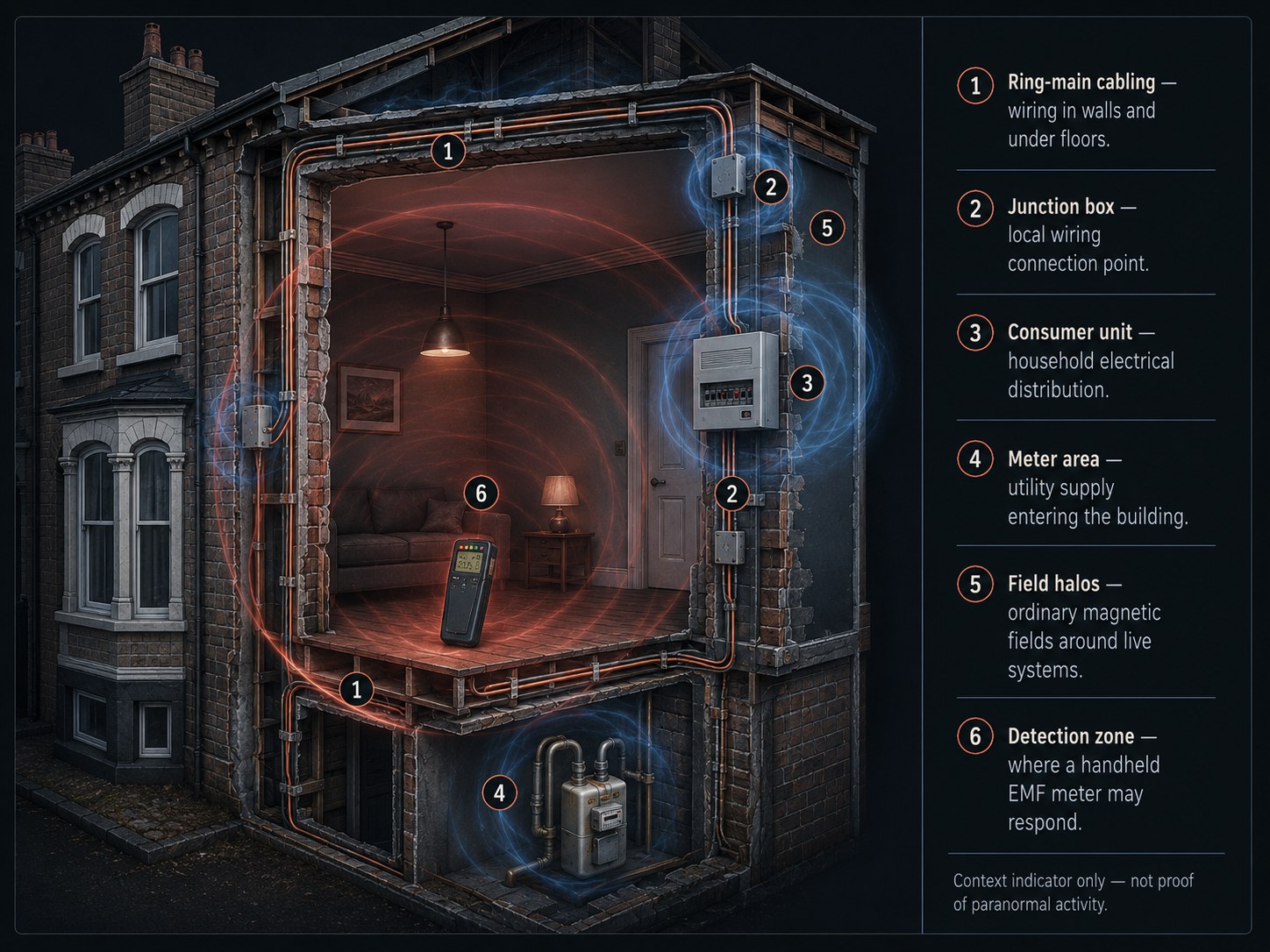
Domestic wiring produces low-level 50 Hz fields around every circuit. Faulty or unbalanced wiring, old ring mains, overloaded circuits and grounding problems can push local fields dramatically higher — sometimes to tens of milliGauss within a metre of the wall. The term "fear cage" (used widely in investigation circles) describes a room or space where high ambient EMF is suspected of contributing to unease, disorientation, or a sense of presence. Persinger & Koren traced reported disturbances at a property in 1996 to a faulty earth in the wiring; a Para.Science investigation of a Cheshire farmhouse in 2003–4 found that the reported experiences faded after a faulty electrical supply cable was repaired. The proposed mechanism — that high chronic EMF might affect temporal-lobe function and produce hallucination-like experiences — comes from Persinger's laboratory work (see Examples). That mechanism is contested and has not been reliably reproduced. "Fear cage" is a useful prompt to go and check for elevated ELF; it is an evocative label, not a confirmed cause. A high reading at the wall is far more often faulty wiring than anything else, and faulty wiring is the first thing to rule out.
The Persinger / God Helmet Research and Its Contested Replication
Neuroscientist Michael Persinger (Laurentian University, Canada) and engineer Stanley Koren built a helmet that applied weak (~1 microTesla) complex magnetic fields to the temporal lobes. Persinger reported that up to 80% of subjects experienced a "sensed presence". A 2000 case study (Persinger, Tiller & Koren, Perceptual and Motor Skills) reported that one participant experienced a full apparition with concurrent EEG paroxysmal activity under laboratory conditions. That is the hypothesis. The evidence against it is strong. In 2005, Pehr Granqvist (Uppsala University) ran a double-blind replication using equipment borrowed from Persinger's own lab. Testing 46 participants, Granqvist et al. found that the presence or absence of the magnetic field had no relationship with anomalous experiences; outcomes were predicted entirely by individual suggestibility and personality traits. The study appeared in Neuroscience Letters (vol. 379, pp. 1–6). Persinger disputed the replication's methodology; Granqvist's team maintained they had followed the agreed procedures. The dispute has not been resolved to the scientific community's satisfaction, and Granqvist's failed replication is widely cited as casting serious doubt on the idea that electromagnetic fields induce a sensed presence. We present both sides plainly: the hypothesis exists, and the best controlled tests of it have not supported it.
Telecom Masts and Mobile Transmitters
Mobile base stations (2G–5G) transmit RF energy in bands from roughly 700 MHz to 3.5 GHz. In the UK, Ofcom requires every spectrum licensee transmitting above 10 W EIRP to demonstrate compliance with ICNIRP general-public limits. Published Ofcom measurement surveys consistently show that real-world EMF levels near mobile masts reach a maximum of 7.1% of ICNIRP limits — far below the threshold for any known biological effect. That is stated plainly: mast RF sits well within safety limits. But a compliant mast still produces a real, measurable RF field, and that field will register on the broadband RF meters used during investigations. Low-risk to health does not mean invisible to your kit.
Broadcast Transmitters
AM radio transmitters operate at 540 kHz–1.6 MHz; FM at 87.5–108 MHz; DAB at 174–240 MHz; TV broadcast at 470–700 MHz. Power levels run from a few watts to over 100 kW effective radiated power. Near a high-power broadcast transmitter, RF field strengths can be substantial; the FCC notes that field strength from fixed transmitters "cannot be predicted theoretically with accuracy" and recommends on-site surveys. Historic investigation sites near broadcast infrastructure — BBC transmitters, legacy IBA towers — may carry elevated background RF that has nothing to do with the location's reputation.
Electrified Rail / Traction Current
DC and 25 kV AC electrified rail systems generate both magnetic fields and stray (leakage) currents. Stray DC from third-rail systems can travel through the ground for tens of metres from the track and produce erratic readings on low-frequency meters. The ASME EMFRail project specifically models rail-traction electromagnetic fields, noting that field strength falls off rapidly with distance from the track axis, but that semi-steady DC and AC traction currents create electromagnetic-compatibility hazards. Victorian railway infrastructure — a frequent subject of location investigations — commonly runs on 750 V DC third rail, so an old station or trackside site can carry a genuine, mundane field load.
EMF Meters and False Positives
This is the most important subcategory for an investigator, because it is about your own kit. Consumer EMF meters cannot tell the difference between a mains cable, a fridge compressor, a colleague's phone and "an anomaly" — they report a field, full stop. Single-axis meters respond only to the axis they point along, so simply rotating the meter changes the reading, which routinely gets mistaken for "something moving". RF-sensitive meters react to any nearby radio device, including the team's own. A meter "going off" is information about the local electromagnetic environment; it is not, by itself, evidence of anything paranormal, and an unmapped site will generate false positives all night.
Examples & documented cases
Persinger & Koren, Field Investigation (1996)
Persinger and Koren investigated a reportedly haunted property where occupants reported sensed presences, fear and light flashes. They traced the electromagnetic spikes that coincided with disturbance reports to a faulty earth in the electrical wiring circuits. Once the electrical fault was identified, no paranormal explanation was required. Cited in: Persinger, M.A. & Koren, S. (2001) in Hauntings and Poltergeists (McFarland). Source review: Psi Encyclopedia (SPR). [9]
Granqvist et al. (2005), Uppsala University
A double-blind replication of Persinger's God Helmet. 46 participants; half received active weak complex magnetic fields, half received sham exposure. No significant difference in anomalous experience between active and sham groups; experiences were predicted by suggestibility scores. This is the strongest controlled test of the Persinger hypothesis to date, and it did not support it. Persinger disputed the methodology; the dispute remains unresolved. Published: Granqvist, P. et al. (2005). "Sensed presence and mystical experiences are predicted by suggestibility, not by the application of transcranial weak complex magnetic fields." Neuroscience Letters 379, 1–6. PubMed: 15849873. [6]
French et al. (2009), "The Haunt Project"
A controlled laboratory study by the Goldsmiths College group (French, Haque, Bunton-Stasyshyn & Davis) exposed 79 participants to infrasound, complex EMF, both, or neither in a purpose-built chamber. No significant differences in anomalous experiences emerged between EMF-active and control conditions. Individual Temporal Lobe Signs scores significantly predicted reported sensations. This second large controlled test also found no support for the Persinger mechanism. Published: Cortex 45, 619–29. PubMed: 18635163. [8]
Para.Science Investigation, Cheshire Farmhouse (2003–4)
A field investigation of a reportedly haunted property recorded extremely high EMF in the rooms associated with experiences. An electrician traced the source to a faulty supply cable. After it was repaired, the reported phenomena ceased. Described by investigators Winsper & Parsons (Para.Science, 2004). This mirrors the Persinger/Koren 1996 case and reinforces faulty wiring as a plausible mundane cause worth ruling out before any paranormal interpretation. [12]
How it affects an investigation
Equipment Affected
Single-axis EMF meters (e.g., TriField Natural EM, mel-meter variants): respond mainly to the axis they are pointed along. Rotating the meter near a wiring source gives very different readings — which is itself a useful sign of a fixed directional source rather than an omni-directional anomaly. K-II / Safe Range K-II: a 5-LED single-axis meter sensitive to 50 Hz–20 kHz, widely used in investigation because its LED bank flashes dramatically. It responds readily to mains wiring, and to RF from mobile phones, walkie-talkies and other investigators' equipment in close proximity. Tri-field (three-axis) meters: measure all three spatial axes at once and are more useful for assessing true ambient field levels — but they are still triggered by every source above. Broadband RF detectors / RF analysers: will detect signals from nearby mobile masts, Wi-Fi access points, broadcast transmitters and other investigators' radio gear. Mobile-phone magnetometer apps: sensitive but unshielded; they pick up the device's own components, its radio hardware, and nearby Wi-Fi. Treat them as indicative at best.
Why Readings Spike
Moving near mains wiring (especially in older or poorly grounded buildings) deflects a meter even without touching anything. Any powered device — fridge compressors, HVAC units, lighting transformers, dimmers — produces a localised field spike in its immediate vicinity. A team member's walkie-talkie or mobile transmitting within 1–2 metres will trigger an RF-sensitive meter. An EM pump (an RF emitter sometimes placed to "attract" activity) will hold elevated readings across the whole space for as long as it runs.
False Positives and Reported Perceptions
Two things follow from the above. First, an unmapped site will produce meter spikes that have ordinary causes — wiring, appliances, the team's own radios. Second, where occupants report unease, disorientation or a sense of presence in a high-EMF room, the honest position is that this may be the mundane environment, suggestibility, or both; the controlled studies (Granqvist; French) did not find that the field itself produces those experiences. Record the readings and the reports, but do not present one as the cause of the other.
What to Control For
1. Pre-investigation baseline sweep: map EMF at every point in the site before any activity begins; note appliances, fuse boards, distribution cables, and any adjacent infrastructure. 2. Electrical fault survey: where very high readings are found (>5 mG sustained), bring in an electrician to identify faulty wiring, unbalanced phases or grounding faults before interpreting anything as anomalous. 3. Radio-silence protocol: switch all walkie-talkies, mobiles and other RF-emitting equipment to silent / airplane mode, and log any unavoidable exceptions. 4. Distance calibration: take readings at 0.5 m, 1 m, 2 m and 5 m from any suspected source. A genuine fixed infrastructure source should show a predictable inverse-square falloff; a reading that does not behave that way is worth flagging — but flag it as unexplained, not as proof. 5. Phase checks: if readings spike intermittently, check whether they line up with known appliance duty cycles — fridge compressor, boiler, lift motor.
Contamination warnings
Recommended equipment
Infographics
On the map
View power-line, substation & mast context on the map
Datasets: (1) High-voltage overhead lines — Electricity Network Model Dataset, Advanced Infrastructure / National Grid Open Data (check per-dataset licence). (2) Distribution substations — Distribution Substations Dataset, National Grid Connected Data Portal (OGL). (3) UK Power Networks substations — Grid and Primary Substations, UK Power Networks Open Data Portal (OGL). (4) Mobile phone base stations — Legacy Sitefinder data (now via UKCellNet, https://www.ukcell.net/); historical Ofcom Sitefinder data released under EIR 2013. (5) Broadcast transmitters — TxParams, Ofcom Open Data (https://www.ofcom.org.uk/about-ofcom/our-research/opendata), OGL v3. (6) Electrified rail — Network Rail infrastructure data, Network Rail Open Data / OS Open Zoomstack (OGL). All layers require attribution; verify current licence terms before data ingestion. These are contamination context tools — they tell an investigator what mundane EMF/RF sources sit near a site so those sources can be checked and controlled for.
Shown as context only — not evidence of paranormal activity.
Connected across PRN
What the evidence does not settle
What is well-established. EMF and RF fields are produced by a wide range of ordinary infrastructure. The consumer EMF meters used in ghost hunting are highly sensitive to all of these mundane sources and cannot distinguish a mains cable from any other field. High ambient EMF in an investigation space is almost always explained by identifiable infrastructure or a wiring fault.
The Persinger hypothesis and its contested replication. The hypothesis that sub-threshold EMF fields can directly induce hallucinations, a "sensed presence", or other experiences interpretable as paranormal rests primarily on Michael Persinger's laboratory work (1990s–2010s). The Granqvist et al. (2005) double-blind replication, using Persinger's own equipment, found that outcomes were predicted entirely by suggestibility, not by the magnetic field. Persinger disputed this, and the dispute has not been resolved to the scientific community's satisfaction. The French et al. (2009) "Haunt Project" — a larger, purpose-built controlled study — found no significant difference between EMF-active and sham conditions. Persinger's original studies drew methodological criticism: incomplete blinding, small samples, and no independent replication in other laboratories.
Why the field strengths involved do not support reliable induction. The field strengths involved in the God Helmet (~1 microTesla) are comparable to those produced by many ordinary environments. If the effect were reliable, it would show up commonly and consistently — and it does not. Higher-frequency RF bands have not been studied in this context at all; the research that exists is on weak ELF/magnetic fields, so nothing here should be extended to RF.
What this means for PRN investigators. A high EMF reading at a site should prompt elimination of infrastructure and wiring contamination first. The "fear cage" concept is a useful checklist item — check for elevated ELF before drawing any conclusion — but investigators must not present elevated EMF as a confirmed cause of experiences. Correlation (high EMF plus an unusual experience) is not cause; the causal direction, if there is one, has not been demonstrated under controlled conditions. The absence of elevated EMF does not "rule out" a paranormal explanation, and its presence does not confirm one. This factor is context and a contamination check — never proof and never a debunk. Ongoing research into ELF/perception interactions is legitimate, but it has not yet produced a reproducible result that would justify a strong causal claim in either direction.
Sources
- [1] "Exposure to low level electromagnetic fields is not harmful to human health" — ICNIRP limits context and WHO International EMF Project position. World Health Organisation, Ongoing (last accessed June 2026) · WHO copyright; cite with attribution.
- [2] UK spectrum licensing, ICNIRP compliance requirements, and measured levels at masts — maximum 7.1% of ICNIRP limits in published surveys. Ofcom, Updated 2024 · OGL v3
- [3] Overview of ELF health research and IARC Class 2B classification for ELF magnetic fields. National Institute of Environmental Health Sciences (USA), 2002 · US Federal government public domain
- [4] German federal authority data on overhead line field strength versus distance; residents within 100 m of a high-voltage line exposed to ~10% higher background fields than general population. Bundesamt für Strahlenschutz (German Federal Office for Radiation Protection), Ongoing · German government; cite with attribution.
- [5] Evidence brief on substation proximity and health; magnetic-field exposure drops steeply with distance and engineering design strongly shapes field footprint. National Collaborating Centre for Environmental Health (Canada), See site · Open access; attribution required.
- [6] Double-blind replication of the God Helmet (46 participants, using Persinger's own equipment): anomalous experiences predicted by suggestibility, not by the magnetic field. No significant difference between active and sham conditions. Elsevier / PubMed, 2005 · Subscription journal; PubMed abstract freely accessible.
- [7] Persinger's 2000 laboratory case study: one participant experienced a full apparition with concurrent EEG paroxysmal activity under weak complex magnetic-field stimulation — the positive experimental claim. SAGE / PubMed, 2000 · Subscription; abstract free.
- [8] The Haunt Project: 79 participants exposed to infrasound, complex EMF, both, or neither. No significant differences in anomalous experiences between EMF-active and control conditions; Temporal Lobe Signs scores predicted reported sensations. Elsevier / PubMed, 2009 · Subscription; author manuscript freely available at https://research.gold.ac.uk/id/eprint/4209/2/French_et_al_Haunt_accepted.pdf
- [9] Electromagnetism and paranormal phenomena — review covering the Persinger/Koren 1996 field case (faulty wiring traced as source of disturbance reports) and wider EMF/haunting research. Society for Psychical Research, Created 2022; last updated May 2026 · SPR copyright; cite with attribution.
- [10] Overview of the God Helmet apparatus, Persinger's claims, and the Granqvist replication controversy. Wikipedia / Wikimedia Foundation, Ongoing · CC BY-SA 4.0
- [11] Published Ofcom 5G measurement data confirming levels well within ICNIRP limits. Ofcom, 2023–24 · OGL v3
- [12] Para.Science field investigation, Cheshire farmhouse: extremely high EMF in reported-activity rooms traced to a faulty supply cable; phenomena ceased after repair. Para.Science, 2004 · Publicly available; cite with attribution.
- [13] EMFRail modelling of rail traction electromagnetic fields; field strength falls off rapidly with distance from track axis but semi-steady DC/AC traction currents create EM-compatibility hazards. ASME, 2017 · Subscription.
- [14] Ofcom Open Data portal for broadcast transmitter parameters (TxParams) — source dataset for UK broadcast transmitter infrastructure layer. Ofcom, Updated ongoing · OGL v3
Further reading
- WHO Q&A: Electromagnetic Fields — World Health Organisation
- Ofcom: Electromagnetic Fields (UK regulatory position) — Ofcom
- Psi Encyclopedia: Electromagnetism and Paranormal Phenomena — Society for Psychical Research
- PubMed: Granqvist et al. (2005) — double-blind God Helmet replication — PubMed / Elsevier
- PubMed: French et al. (2009) — The Haunt Project — PubMed / Elsevier
- BfS: Field Strain Due to High-Voltage Lines — Bundesamt für Strahlenschutz (German Federal Office for Radiation Protection)