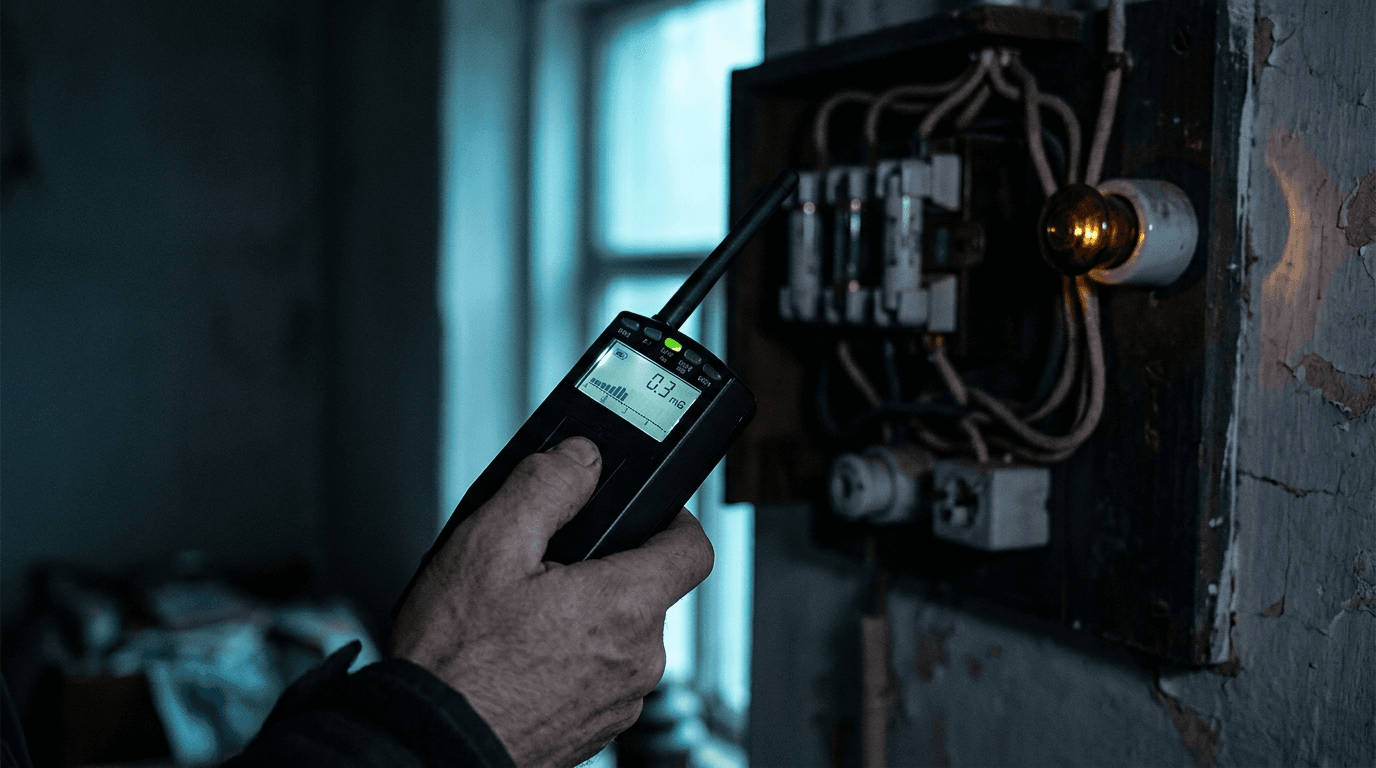
What an EMF meter actually measures (and what it doesn't)
The K2 meter is one of the most recognisable pieces of paranormal investigation kit. But what is it actually detecting? The honest answer matters more than most guides admit.
Walk into almost any paranormal investigation and you will find an EMF meter — most likely a K2 with a row of coloured LEDs. When the lights flicker, the moment feels significant. But what is the instrument measuring, and what are its limits?
What EMF meters measure
An electromagnetic field meter measures electromagnetic radiation in the environment. Different models measure different things: alternating electric fields, magnetic flux density, or radio-frequency energy. Most consumer models — including the K2 — are calibrated to detect the 50 Hz or 60 Hz alternating fields produced by mains electrical wiring. That is what they were designed to find. The K2 is a single-axis device with an LED bar-graph and no data logging; it was designed as a consumer electrical tool for locating wiring faults, not for paranormal work.
What causes false positives
Consumer EMF meters respond to mobile phones, Wi-Fi routers, walkie-talkies, camera wireless systems, dimmer switches, poorly grounded wiring, and simply moving through an existing field. In a building with old or unshielded wiring, baseline levels can be elevated throughout. Without data logging, there is no timestamped record to correlate a reading with audio or video captured at the same moment.
The contested science
The hypothesis that electromagnetic fields cause paranormal-seeming experiences was proposed by Michael Persinger and explored through his "God Helmet." Independent double-blind replications found that the device's electromagnetic parameters did not predict anomalous experiences — suggestibility did, regardless of whether the device was active. This hypothesis remains disputed and must not be presented as established fact. Separately, the World Health Organization notes that people reporting electromagnetic hypersensitivity cannot detect EMF above chance under blinded conditions.
What EMF meters are useful for
They are legitimate tools for mapping the electrical environment of a location — ruling out electrical sources for reported phenomena, and identifying faulty wiring that warrants an electrician regardless of any investigation. PRN's Evidence Guides cover EMF meter limitations in full.
Sources: Wikipedia — EMF measurement; ICNIRP RF Guidelines 2020; Wikipedia — God Helmet, citing peer-reviewed replication studies; WHO EMF Q&A.