Infrasound: the sound you can't hear that can make a room feel haunted
An invisible wave below the threshold of human hearing can produce dread, nausea, and shadowy shapes at the edge of your vision. A Coventry engineer traced exactly this phenomenon to a single extractor fan.
In 1998, Vic Tandy — an engineer at Coventry University — published a paper in the Journal of the Society for Psychical Research titled "The Ghost in the Machine." Its conclusion was not that the laboratory was haunted.
What Tandy found
Tandy and his colleagues had been experiencing persistent feelings of dread in their laboratory. Tandy reported glimpsing a grey shape in his peripheral vision that disappeared when he looked directly at it, and noticed his fencing foil vibrating in a vice with no apparent cause. Investigating the vibration, he identified a standing wave of approximately 18.98 Hz produced by a newly installed extractor fan — below the threshold of human hearing. When the fan was adjusted to remove the standing wave, the unease and the peripheral disturbances stopped.
Why 18–19 Hz in particular?
One proposed mechanism — which Tandy described as a hypothesis, not a confirmed fact — is that this frequency is close to the resonant frequency of the human eyeball, so minor oscillations could produce visual disturbances in the periphery. This specific mechanism has not been independently confirmed under controlled conditions and should be treated as a working hypothesis. What is better established is that infrasound at sufficient levels can produce documented physiological effects, including raised cortisol, anxiety, irritability, and nausea — confirmed again by a 2026 study in Frontiers in Behavioral Neuroscience.
Where infrasound comes from in buildings
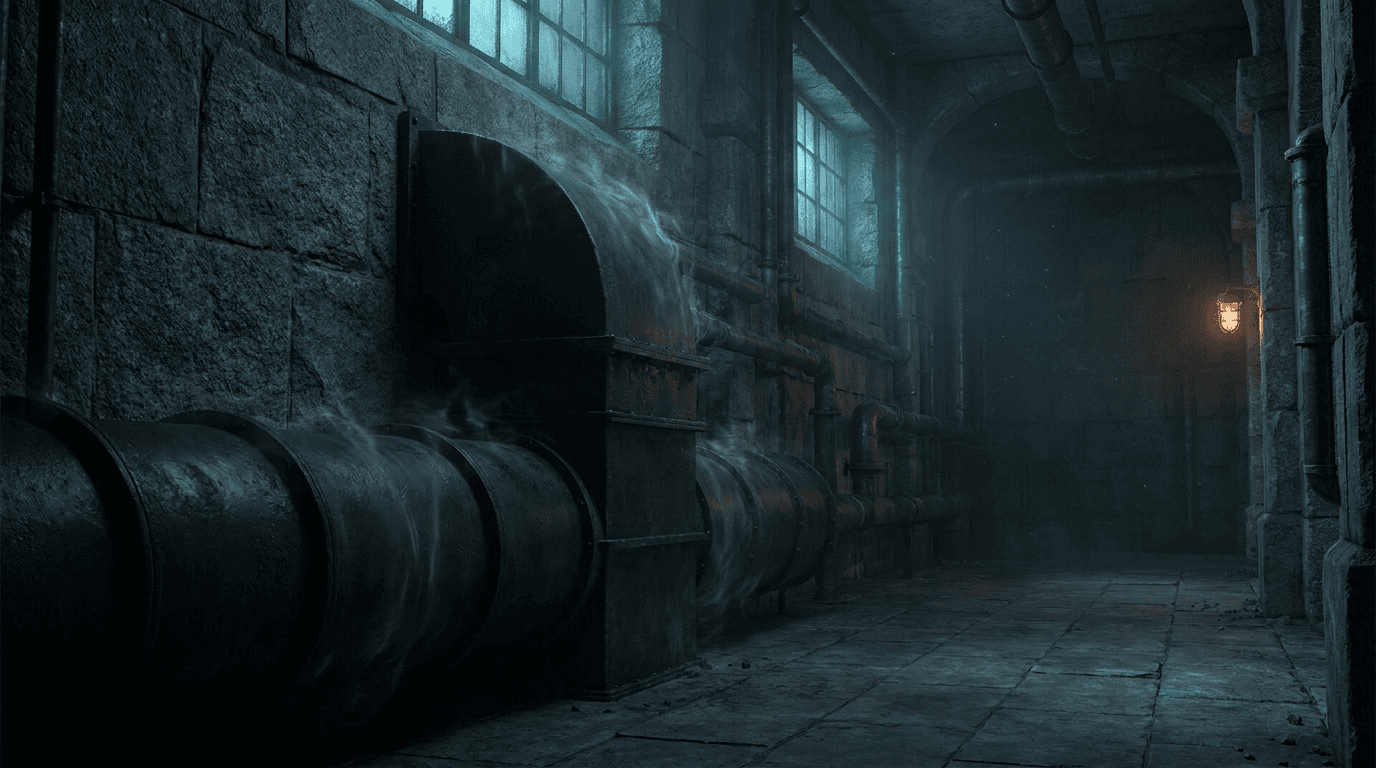
Common sources include extractor fans, large HVAC systems, heavy road traffic, wind across chimneys or rooftops, and industrial machinery nearby. These are worth checking when a location reports persistent unease with no obvious cause. Infrasound is a plausible contributing factor in some reported hauntings and a legitimate area of investigation — but it does not explain all reported experiences, and PRN treats it as one environmental variable to check, not a universal answer.
Sources: Tandy, V. & Lawrence, T. R. (1998), "The ghost in the machine," Journal of the Society for Psychical Research, 62(851); Frontiers in Behavioral Neuroscience (2026), doi:10.3389/fnbeh.2026.1729876; Wikipedia — Vic Tandy.