Historical Origins
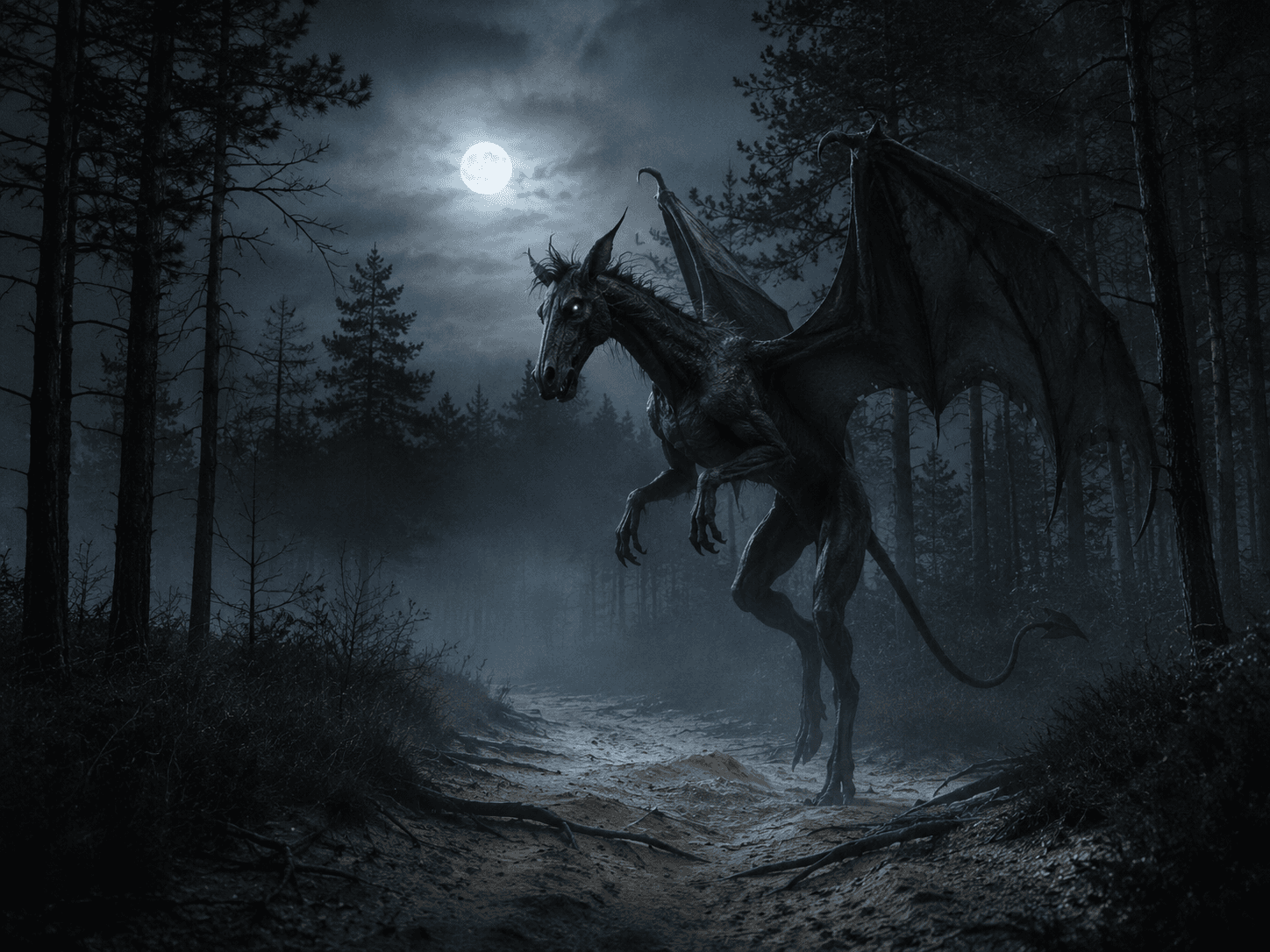
The canonical origin legend centres on a woman known as Mother Leeds, identified variously as Jane Leeds or Deborah Leeds, said to have lived in the Pine Barrens in the early eighteenth century. According to the legend, upon discovering she was pregnant with her thirteenth child, she cursed the unborn infant — in some versions saying "let it be the devil" — and when the child was born, it transformed into a monstrous creature, killed or drove away the midwives present, and flew up the chimney into the Pine Barrens. This narrative was not recorded in its fully developed form until the nineteenth century, and researchers have debated how much of it reflects genuine eighteenth-century oral tradition versus later elaboration.
The Leeds family was real. A Daniel Leeds emigrated from England to New Jersey in the 1670s and settled in Burlington County, within the region later associated with the legend. His son Titan Leeds became a prominent almanac publisher whose rivalry with Benjamin Franklin is documented; Franklin famously predicted Titan Leeds's death in his almanac as a satirical jab. The family used a heraldic device bearing a wyvern (a dragon-like creature) on their publications. Folklorist Brian Regal of Kean University has argued in published research that the Leeds family's reputation for occult and heterodox beliefs may have seeded a demonizing local legend, and that the "Leeds Devil" was initially a piece of social and religious slander rather than a creature report.
The earliest datable written references to the Leeds Devil as a creature appear in the mid-nineteenth century. Research by folklorists James F. McCloy and Ray Miller Jr., summarized in their 1976 book The Jersey Devil (Middle Atlantic Press), found no contemporary eighteenth-century documentation of the origin legend. The creature seems to have consolidated into its current form through the nineteenth century, absorbing elements of older Pine Barrens folklore about strange sounds, lights, and presences in the forest.
The creature achieved national notoriety during the week of January 16–23, 1909, in what newspapers of the period called the "phenomenal week." Over approximately five days, hundreds of people across New Jersey, Delaware, and southeastern Pennsylvania reported encounters with a winged creature leaving unusual tracks, producing strange sounds, and being seen in flight. Reports came from Bristol, Pennsylvania; Burlington and Camden, New Jersey; Haddonfield; Woodbury; and numerous other communities. The Philadelphia and Camden newspapers carried daily front-page coverage. A posse of hunters in Burlington reportedly tracked strange hoof prints in snow. A trolley car driver in Haddon Heights reported the creature landing on his car roof. A police officer in Camden reported firing at a creature that flew away apparently uninjured.
Historians and folklorists have examined the 1909 wave extensively. Several hoaxes were documented during the period itself: a Philadelphia museum owner named Jacob Hope briefly displayed a kangaroo with fake wings painted green and billed it as the captured Jersey Devil. Folklorist Jan Harold Brunvand, who documented the case in his reference works on American urban legends, noted that the 1909 outbreak displayed classic features of mass social contagion: initial reports amplified by newspaper coverage, a period of escalating excitement, and rapid decay once the media cycle passed.
Two famous historical figures are associated with Jersey Devil sightings, though documentation is thin. Commodore Stephen Decatur, the naval hero, is said to have fired a cannonball at a creature while testing artillery at Hanover Iron Furnace around 1820. Joseph Bonaparte, the elder brother of Napoleon and former King of Spain, who lived in exile at his Bordentown estate in New Jersey from 1816 to 1839, is said to have encountered the creature while hunting in the Pine Barrens. Neither account is supported by contemporary documentation; both may be later embellishments designed to give the legend aristocratic cachet.
Throughout the twentieth century, sightings continued at a lower intensity. Reports clustered in 1951 (Gibbstown, NJ) and the 1960s. The New Jersey Devils hockey team, founded in 1982, adopted the name directly from the legend. The creature appeared in The X-Files (Season 1, episode "The Jersey Devil," 1993) and numerous other cultural productions.