Historical Origins
The first cluster of Chupacabra reports emerged in the municipality of Canóvanas, Puerto Rico, beginning in early March 1995. Farmers reported finding goats, chickens, and other small livestock dead, drained of blood through one or more puncture wounds, with no obvious sign of conventional predation. The deaths were real and numerous: by some local tallies, more than 150 animals died in the Canóvanas area during 1995.
The creature responsible acquired its name not from a witness but from comedian and radio personality Silverio Pérez, who coined the term chupacabras during a broadcast that year as a sardonic label for whatever was responsible. The name stuck immediately.
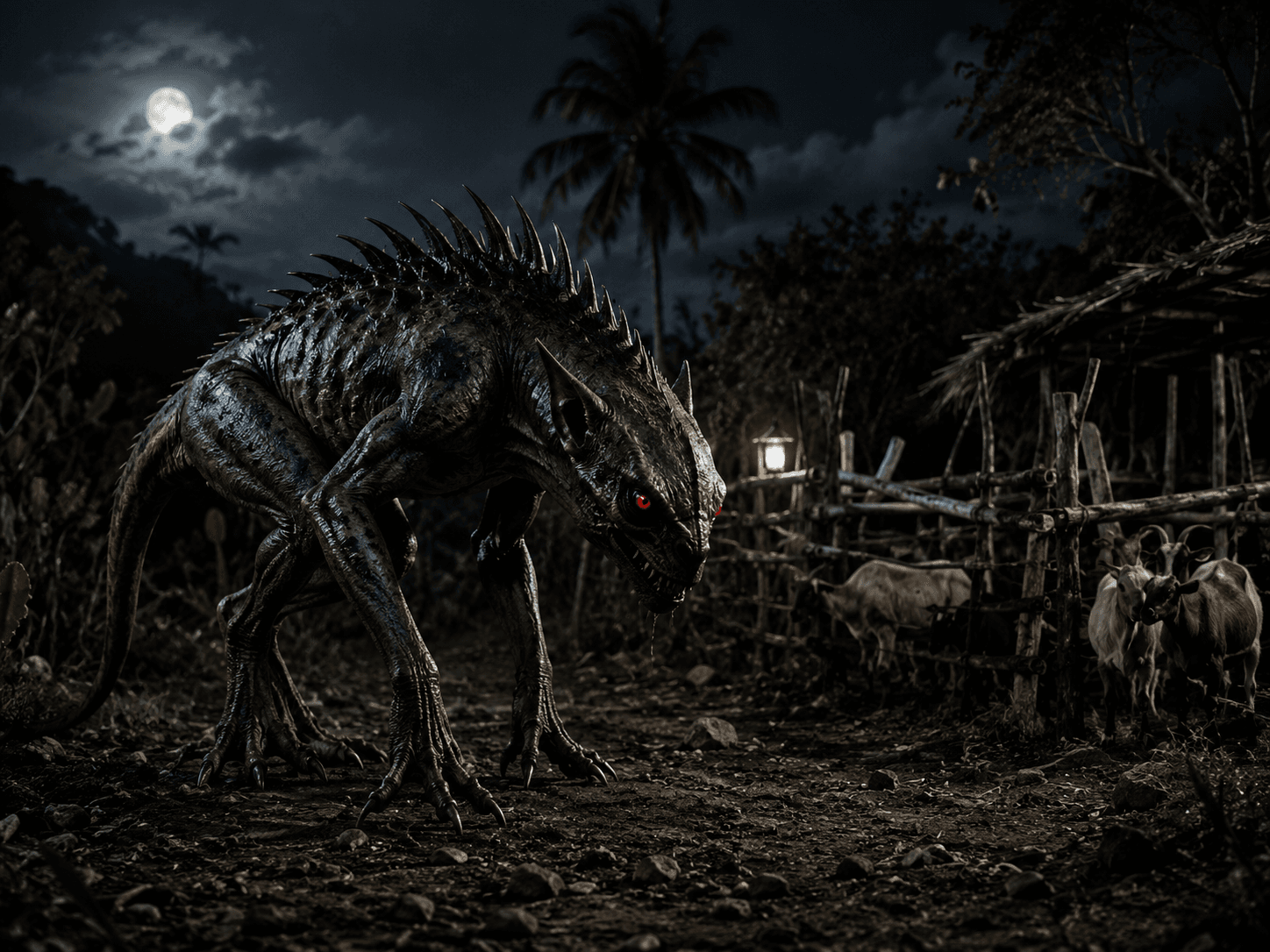
The pivotal witness account came from Madelyne Tolentino of Canóvanas, who reported a close sighting in August 1995. Her description — a bipedal entity standing roughly three to four feet tall, with a row of spines or quills running down its back, large red eyes, grey or greenish skin, and powerful hind legs — became the canonical physical description reproduced in newspaper reports across the island and across Latin America. Investigative researcher Benjamin Radford later interviewed Tolentino extensively for his 2011 book Tracking the Chupacabra (University of New Mexico Press) and established that her description closely matched the alien creature Sil from the 1995 science fiction horror film Species, which Tolentino confirmed she had seen shortly before her sighting. Radford concluded that the Puerto Rican Chupacabra was, in significant measure, a film monster translated into eyewitness testimony through the well-documented mechanism of source monitoring error.
The legend had an important Puerto Rican precursor. In 1975, the town of Moca experienced a wave of livestock deaths attributed to a mysterious predator; press coverage referred to the culprit as El Vampiro de Moca. No creature was ever identified, and the deaths were ultimately attributed to predators and decomposition artefacts, but the 1975 episode established a template of vampiric livestock predation in Puerto Rican popular memory that the 1995 wave drew upon directly.
By the late 1990s, Chupacabra reports had spread to Mexico, Brazil, Chile, Argentina, Colombia, and the continental United States. The creature's description mutated considerably in transit, with Mexican and South American variants diverging from the Puerto Rican form. When hairless, mange-afflicted coyotes and dogs began appearing in Texas in the early 2000s, local media and the public rapidly designated them "Chupacabras," creating the second, canid version of the legend. Wildlife biologists who tested recovered carcasses consistently identified them as canids — coyotes, domestic dogs, or hybrids — suffering from severe sarcoptic mange.