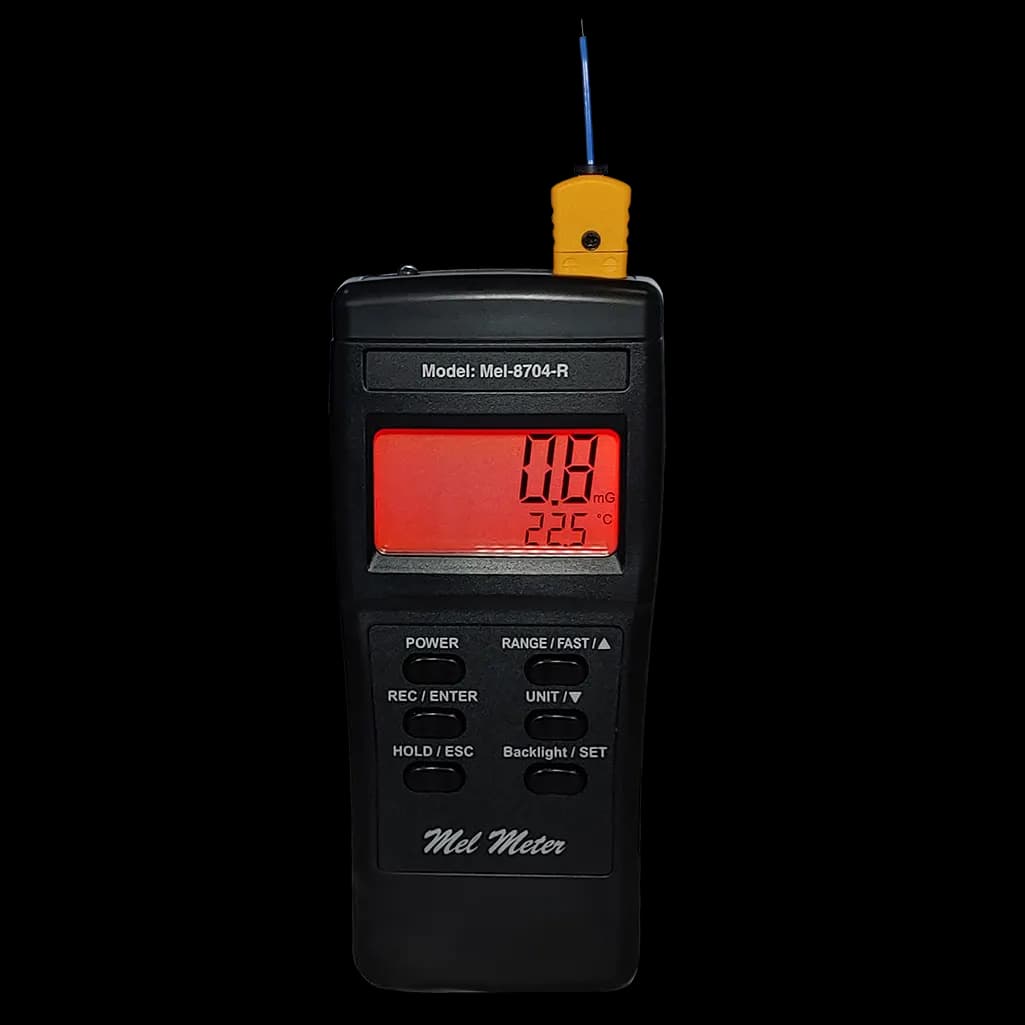
Mel 8704R Paranormal Ghost Hunting 3 in 1 Instrument
Mel
£179.99
External seller information. PRN does not sell this product and does not imply endorsement.
A 3-in-1 paranormal investigation instrument designed for ghost hunting and detecting electromagnetic phenomena.
External seller
Seller & availability
External seller information. PRN does not sell this product and does not imply endorsement.
This product is sold by an external seller. PRN hosts directory information only and does not process purchases.
Field reference
Potential Field-Use Benefits
Combines an EMF meter and a thermometer in one handheld unit, letting an investigator log electromagnetic and temperature readings together. Baseline sweeps and known sources (wiring, appliances, heating) should be recorded first so changes can be interpreted in context.
PRN has not tested or reviewed this product. This information is provided for reference only.
Technical
Specifications
Light
Red backlight + high-intensity red torch
Modes
Min/Max/Hold, EMF Burst (100msec)
Probe
1 inch K-Type Thermocouple
Battery
1x 9Vdc Alkaline (included)
Readouts
mG or uT, F or C
EMF Range
30Hz to 300Hz
Functions
EMF meter, temperature meter, light
Understanding the tech
How it works
Environmental sensors convert a physical quantity into an electrical reading:
Temperature sensors (thermistor or digital probe) report air or surface temperature; a "temperature change" sensor watches for a rapid rise or fall and alerts on it.
Humidity sensors measure relative humidity, usually via a capacitive element whose value changes with absorbed moisture.
Barometric pressure sensors (e.g. BMP280) measure atmospheric pressure and small changes in it, often alongside temperature.
Ambient light sensors report illumination level.
Motion / tripwire sensors (passive infrared, or beam-break) flag when something crosses a detection zone.
Combination units (the Mel 8704R bundles EMF, temperature and light) simply place several of these sensors in one housing. In paranormal work these readings are logged as context — a sudden draught, a pressure swing, a temperature drop — that can be cross-referenced against anything else observed.
Use with care
Limitations
Sensors lag and average. Air-temperature probes respond slowly and read the air immediately around the probe, so a "cold spot" detected in one position may simply be a draught or the probe equilibrating.
They measure the cause-agnostic quantity only. A temperature drop is a temperature drop; the instrument cannot attribute it to a source.
Placement dominates the reading. Near a window, door, vent, exterior wall or the investigators' own bodies, readings move for ordinary reasons.
Motion / tripwire sensors fire on anything in the zone — people, pets, insects, blowing curtains — and PIR units specifically respond to moving heat, including draughts of warm air.
Consumer sensors have real tolerances and can drift; two meters in the same room can disagree.
Read the data critically
Common false positives
Draughts and HVAC cycling producing temperature and "cold spot" swings.
Doors/windows opening, weather fronts and altitude effects moving pressure and humidity.
Body heat and breath of the investigators warming or humidifying the local air.
Motion sensors tripping on insects, pets, curtains, the team's own movement, or warm-air currents (for PIR).
Sensor drift, slow response and unit-to-unit disagreement.
Best practice: establish a baseline for each quantity before the session, record where each sensor sits relative to vents/windows/people, expect environmental causes first, and corroborate any change across more than one instrument before treating it as notable. These are standard environmental instruments; none is validated as a detector of anything paranormal.
PRN has not tested or reviewed this product. This guidance describes the device class and is provided for reference only.
Paranormal Response Network is not a seller, reseller, certifier, or safety authority for any equipment shown here. Listings may include vendor-submitted, sponsored, affiliate-linked, imported, or externally sourced information. Presence in this directory does not mean PRN has tested, endorsed, or approved any product or vendor.